Let’s be honest.
When most people get to Leviticus during their Bible reading plan, things get… difficult.
There are laws.
Then more laws.
Then laws about the laws.
And somewhere around chapter 13, people start wondering if skipping ahead to Psalms is acceptable.
But hidden within all those regulations are some surprising insights about women, dignity, health, family, and God’s concern for everyday life.
Leviticus may not give us famous women like Sarah or Deborah, but it does reveal something fascinating:
God cared about women even in the details.
The Big Idea of Leviticus
Leviticus is all about holiness.
God was teaching Israel how to live as His people in a world that looked very different from the one He intended.
Many of the laws seem strange to modern readers, but they were often designed to create order, protection, and distinction between Israel and surrounding nations.
And women were included in those instructions.
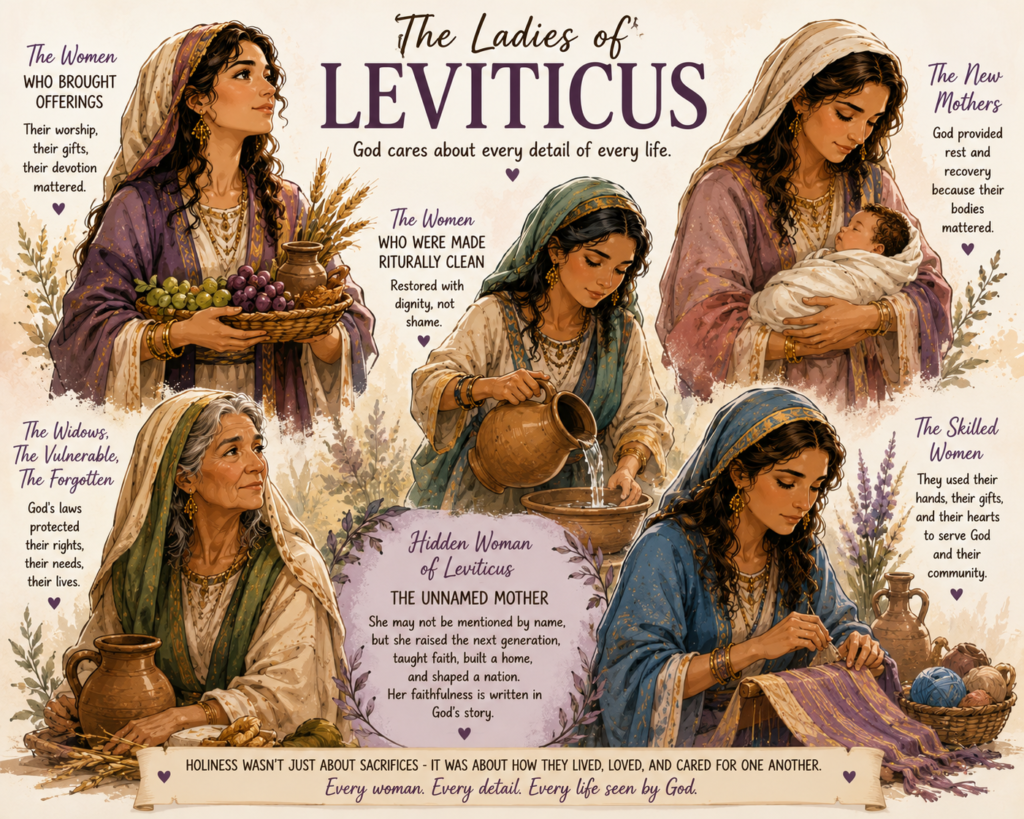
The Women Who Brought Offerings
One detail often overlooked is that women could bring sacrifices and offerings directly to God.
While ancient cultures frequently pushed women to the margins, God made provision for women to participate in worship.
Their relationship with God mattered.
Not because they were wives.
Not because they were mothers.
Because they were His people.
That was significant in the ancient world.
The Women Who Needed Rest
Leviticus discusses childbirth and physical recovery after birth.
Today these passages can sound confusing or even offensive when read without context.
But here’s an interesting perspective:
In a world where women were often expected to return immediately to work and responsibilities, God built recovery periods into Israel’s society.
The law acknowledged that childbirth affected a woman’s body and that recovery mattered.
That may not sound revolutionary today, but in the ancient world it was remarkably practical.
The Women Protected by Community Laws
Leviticus contains laws about caring for the vulnerable, the poor, foreigners, widows, and those without support.
While women are not always named directly, they were among those most affected by these protections.
God wasn’t only interested in worship inside the Tabernacle.
He was interested in how people treated one another outside it.
A holy nation was supposed to be a compassionate nation.
The Skilled Women of Israel
When we read the books surrounding Leviticus, we discover women contributing skills, craftsmanship, and resources to God’s work.
Leviticus reminds us that worship wasn’t just singing or sacrifice.
It included serving, giving, creating, and participating in community life.
Not everyone stood in front.
Many served faithfully behind the scenes.
The New Mother
Unlike Genesis or Exodus, Leviticus doesn’t spotlight a specific woman by name.
So our Hidden Woman of the Book is one of the unnamed mothers who appear in the laws surrounding childbirth.
Why?
Because unnamed does not mean unimportant.
Thousands of women lived ordinary lives while raising families, managing homes, preserving traditions, and teaching future generations.
The Bible often focuses on leaders and major events, but every nation is built on ordinary people doing ordinary things faithfully.
These mothers may not have had their names recorded, but their influence shaped Israel’s future.
History rarely remembers every name.
God does.
What This Means for Women Today
Leviticus reminds us that:
- God cares about the details of your life.
- Physical health matters.
- Rest is not laziness.
- Everyday faithfulness is valuable.
- You don’t need a public platform to have a lasting impact.
In a world obsessed with visibility, Leviticus quietly teaches that significance isn’t measured by attention.
Some of the most important work happens where nobody is applauding.
Did You Notice?
Many biblical women are unnamed.
We tend to focus on the famous ones, but Scripture is filled with women whose names we never learn.
Their stories remind us that God sees people differently than the world does.
A person doesn’t become important because they’re famous.
They’re important because they’re known by God.
✨ Final Thought
Leviticus may not seem like a book about women.
But look closer.
Behind the laws are mothers, daughters, widows, worshippers, workers, and caregivers—all living ordinary lives under the care of an extraordinary God.
And maybe that’s the hidden lesson of Leviticus:
You don’t have to be famous to matter.
Sometimes the women hidden in the fine print are carrying the story forward just as much as the people in the headlines.